What Is an Air Gap in Secondary Glazing? And Why It Matters
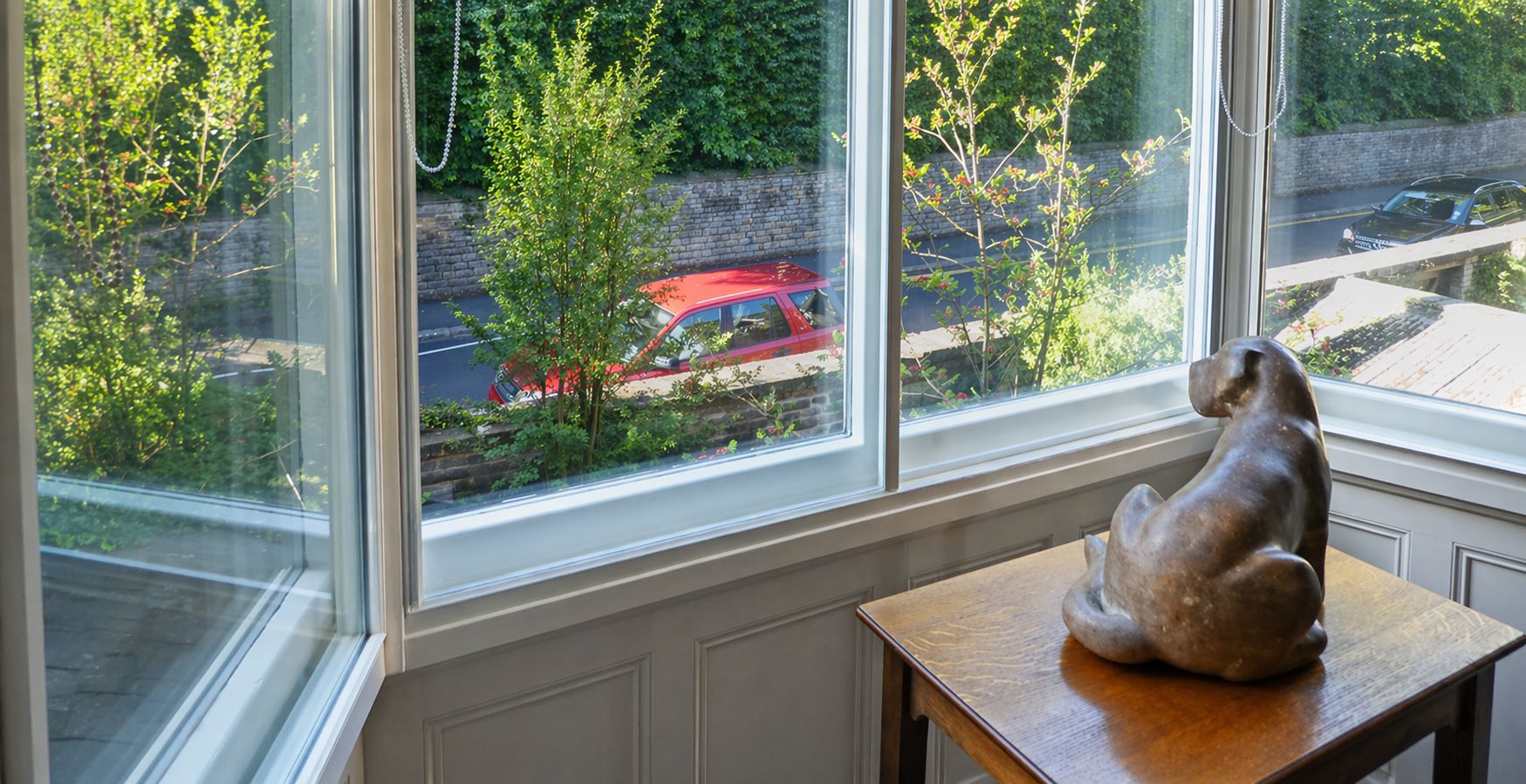

There’s a big factor that determines how well your secondary glazing performs, and it isn’t the glass. It’s the space between your existing window and the new secondary panel. Get that space right, and you’ll reduce noise by up to 80% and bring your U-value down to 1.868 W/m²K. That space is called the air gap. It’s the most misunderstood part of secondary glazing, and the one that makes the biggest difference.
What Does “Air Gap” Mean?
In secondary glazing, the air gap is the distance between the inner face of your existing window and the inner face of the new secondary panel sitting behind it. The two panes of glass aren’t touching. They’re separated by a layer of still air, and that air does most of the acoustic and thermal work.
It’s the same physics that makes a vacuum flask work, scaled up to fit a window. Still, trapped air is one of the poorest conductors of heat and sound that exists. The more of it you have, the harder it is for noise and cold to travel through.
This is why secondary glazing consistently outperforms double glazing for sound insulation, despite the fact that a sealed double-glazed unit uses the same core principle. The air gap in a standard double-glazed unit is typically 12–16mm. The air gap in secondary glazing can be 100mm, 150mm, even 200mm.
Why the Air Gap Changes Everything for Noise Reduction
Secondary glazing can reduce outside noise by over 50 decibels. That’s five times more than double or triple glazing. The air gap is the primary reason for that difference. Sound travels as waves. Those waves pass easily through glass, but they lose energy every time they hit a boundary and have to cross a different medium. The larger the air gap, the more energy the wave loses in transit. A narrow gap gives the sound wave very little time to dissipate. A wide gap forces it to travel further, losing more energy along the way, before it even reaches the secondary glass.
Here’s what that looks like in practice:
- 4mm toughened glass with the right air gap achieves approximately 45 dB reduction
- 6mm toughened glass with the same air gap achieves approximately 49 dB or more
- Acoustic laminate glass (Stadip Silence PVB) with an optimum air gap achieves 51 to 53 dB
The glass matters. But the air gap matters more. A 6mm pane in a 40mm air gap will underperform a 4mm pane in a 150mm air gap. Every time.
How Much Air Gap Do You Need?
For noise reduction, the minimum air gap is 100mm. Below that, you’re leaving a significant portion of the acoustic benefit on the table.
The optimal range is 150 to 200mm. At that distance, the secondary panel has room to do its job properly, and you’ll achieve results at the top end of the performance range. Most installations achieve 150mm without any difficulty, because the secondary panel typically sits within the window reveal, behind the primary glazing.
If you’re fitting secondary glazing yourself, this is worth measuring before you order. Take the depth of your window reveal, from the inner face of the existing glass to the innermost point of your window frame, and calculate what air gap is achievable. If you’re in a Georgian or Victorian property with deep reveals, 150mm is often straightforward. In shallower reveals, you may need to consider reveal fixing rather than face fixing to push the secondary panel further back.
Why the Air Gap Matters for Thermal Performance
The relationship between air gap and thermal performance follows slightly different rules. For heat retention, a large air gap is not always better. Once the air in the gap becomes deep enough to allow convection currents to circulate, it starts conducting heat rather than trapping it. For thermal insulation, the optimum air gap is 50 to 80mm. That’s the range at which still air is most effective at acting as a thermal barrier, and where our secondary glazing achieves a certificated U-value of 1.868 W/m²K, compared to approximately 5.8 W/m²K for single glazing.
That’s a thermal improvement of up to 65%.
Glasgow University research, commissioned by English Heritage and Historic Scotland, confirmed that secondary glazing outperforms double-glazed replacements for thermal efficiency in traditional buildings. A significant part of why it performs so well comes down to the physics of the air gap.
If you’re fitting secondary glazing primarily for noise, you’ll want the largest air gap you can achieve in your reveal. If thermal performance is the priority, 50 to 80mm is the sweet spot. In most cases, an installation in a period property will achieve somewhere between 80mm and 150mm, which delivers strong results on both fronts.
How the Air Gap Affects Your Choice of Fixing Method
The fixing method you choose directly affects how large an air gap you’ll achieve, and that’s worth knowing before you place an order.
Face fixing attaches the secondary panel to the front face of your existing window frame. It’s the default method, and it typically produces the smallest air gap of the three options. In most properties, you’ll still achieve a workable gap, but if maximising acoustic performance is the priority, it’s worth considering the alternatives.
Reveal fixing screws the secondary panel into the side walls of the window reveal rather than the frame itself. This positions the panel further back in the reveal, increasing the air gap and delivering better sound insulation as a result. It’s particularly effective in period properties with deeper reveals.
Surface mounting fixes the panel directly to the internal wall surrounding the window. This is the most flexible option in terms of positioning, and it can produce the largest air gap where the reveal depth allows it. If you’re not sure which method suits your property, our team can advise before you order. It’s a question that comes up regularly, and the answer varies depending on your window type, reveal depth, and what you’re trying to achieve.
What Happens If the Air Gap Is Too Small?
A gap that’s too narrow reduces both acoustic and thermal performance. For noise reduction, anything under 80mm starts to compromise results noticeably. Under 50mm and you’re beginning to approach the performance levels of a standard double-glazed unit rather than secondary glazing. That’s still a meaningful improvement over single glazing, but it’s well short of what secondary glazing can achieve when fitted correctly.
This is one of the reasons we always ask customers to measure their reveal depth before ordering, and why our DIY secondary glazing guides include clear instructions on calculating available air gap. Getting it right at the measuring stage costs nothing. Ordering a system that doesn’t achieve the air gap you need costs time.
Choosing the Right Secondary Glazing System
Every window we manufacture is made to measure, which means the air gap is something we design around from the outset rather than working with whatever space happens to be left. Our full range of secondary glazing systems includes horizontal sliders, vertical sliders, hinged casements, lift-out panels, and bespoke units for shaped windows, all of which can be positioned to maximise the available air gap in your reveal.
We’ve been manufacturing secondary glazing in the UK for more than 20 years. Our systems are fitted in over 10% of the historic properties listed on britainsfinest.co.uk, including Sudbury Hall, Hardwick Hall, Belton House, and Kedleston Hall for the National Trust. The air gap question is one we’ve answered for thousands of customers across every property type imaginable, from Georgian townhouses to Victorian terraces to Edwardian bay-windowed semis.
All of that experience goes into the advice we give. Whether you’re ordering DIY secondary glazing or booking professional installation, we’ll help you calculate the right air gap for your specific window before anything is manufactured. Our 10-year guarantee on aluminium frames and glazing covers everything once it’s in place. You can find more detail on what’s included on our about us page.
Ready to find out what’s achievable in your property? Get an instant quote using our FastQuote tool, or browse the full range to find the right system for your windows.